
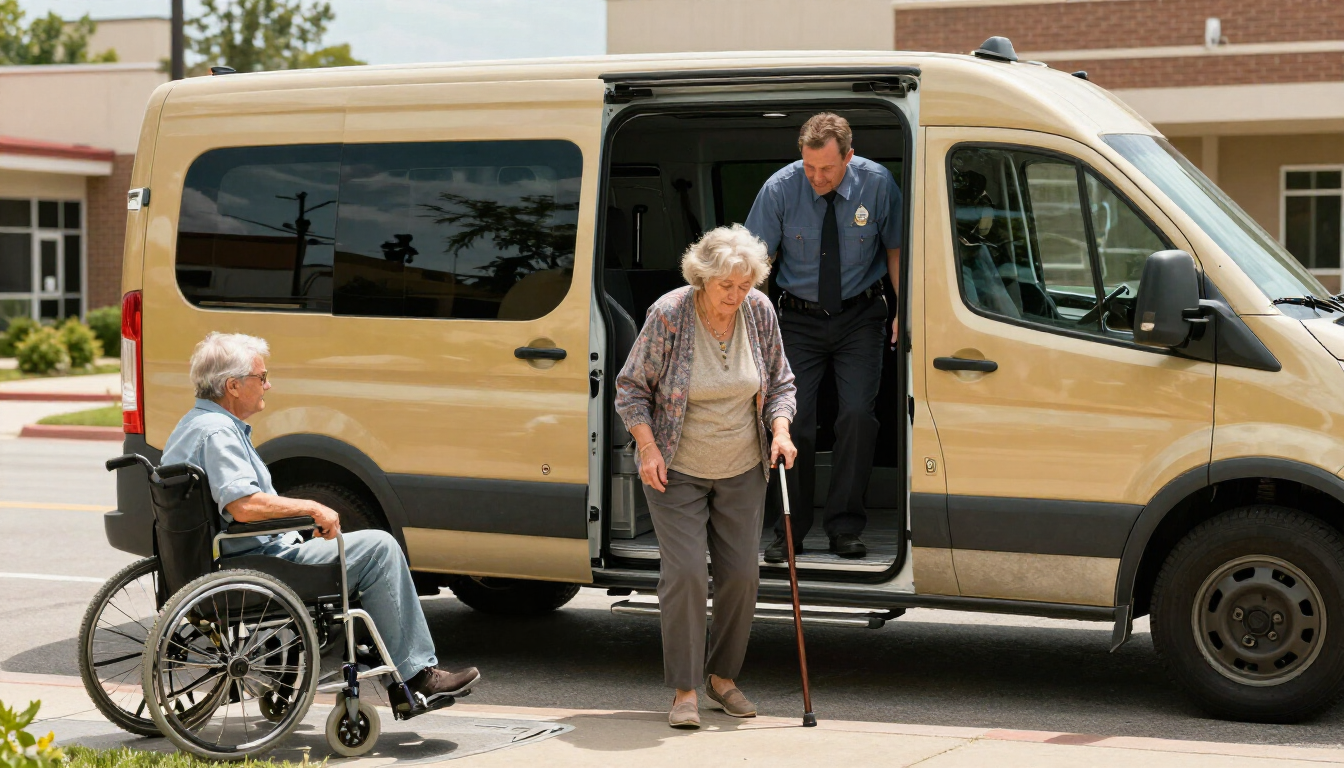
When you call to book a medical ride, the first question a dispatcher will ask is whether the passenger is "ambulatory" or needs a "wheelchair transport." If you've never booked non-emergency medical transportation (NEMT) before, those two terms can feel confusing — and picking the wrong one can mean a vehicle that isn't equipped for your loved one, a delayed pickup, or a frustrating morning for everyone involved.
What "Ambulatory" Actually Means
Ambulatory simply means the passenger can walk. An ambulatory rider is someone who is able to get in and out of a vehicle on their own, or with a steadying arm and minimal assistance.
That does not mean the person is fully independent. An ambulatory passenger may still use a cane, a walker, or need the driver to hold an elbow on stairs. They may be recovering from a minor procedure, feeling unsteady after dialysis, or simply an older adult who no longer drives but gets around fine once they're inside the building.
Ambulatory transport uses a standard sedan or minivan. There is no ramp, no wheelchair securement, and no lift. The value is in the door-to-door assistance and the trained, patient driver — not in specialized equipment.
What "Wheelchair Transport" Means
Wheelchair transport (sometimes called "stretcher" or "bariatric" transport depending on the equipment) is for a passenger who cannot safely transfer out of their wheelchair for the trip, or who cannot walk from the home to the vehicle at all.
These vehicles are equipped with a ramp or lift and a professional securement system. The passenger stays in their wheelchair for the entire ride, and the driver locks the chair to the floor using a four-point tie-down system (like the Q’Straint Q’TRAX L-Track) plus a lap and shoulder belt.
Wheelchair transport is the right choice when the passenger:
- Uses a wheelchair full-time
- If the wheelchair is how they move through their home and the world, they should ride in it — not be transferred in and out of a car seat.
- Cannot safely stand or pivot
- A passenger who is unsteady, at risk of falling, or unable to bear weight (after a hip surgery, for example) should not be transferred into a standard vehicle seat.
- Uses a power chair or a bariatric chair
- These chairs are heavy and difficult to transfer out of. A wheelchair-accessible vehicle carries the chair and the passenger together.
The Gray Area: "They Can Walk, But…"
Most confusion happens in the middle. A parent can walk across the living room, so the family books an ambulatory ride — then the driver arrives and the passenger cannot make it down the porch steps.
When in doubt, ask yourself one question: can the passenger walk from their front door to the vehicle and then from the vehicle into the clinic, with no more than a steadying arm? If the honest answer is no, book a wheelchair transport. It is almost always better to have a ramp you didn't need than to need a ramp that isn't there.
A few common situations that trip families up:
- Uses a walker, not a wheelchair
- If they can walk with the walker and the driver can fold and stow it, ambulatory transport is usually fine. Just tell the dispatcher about the walker so the right vehicle comes.
- Tires easily after a long appointment
- If the passenger can walk in but may be exhausted on the way out, ask about a wheelchair transport for the return trip, or book a "wait-and-return" ambulatory ride.
- Recently fell or feels unsteady
- When balance is in question, a wheelchair transport removes the fall risk entirely. Err on the side of caution.
Why It Matters for Cost and Scheduling
Ambulatory and wheelchair transports are priced and scheduled differently. Wheelchair vehicles are specialized, so there are fewer of them on the road — which means booking further ahead matters, especially for early-morning dialysis or discharge pickups.
At Pinnacle Transport, our transparent rate structure keeps it simple: wheelchair transport starts at $45.00 for the first 5 miles, and ambulatory rides start at $30.00. After 5 miles, both are $2.75 per mile, and the first 15 minutes of wait time is free — after that, wait time is $10.00 for every 15 minutes. A family companion rides free, and there is never a curb-to-curb upcharge — every ride is door-to-door.
Knowing which type of ride you need before you call helps us send the right vehicle, give you an accurate quote, and get your loved one there on time.
Frequently Asked Questions
Can a wheelchair passenger ride along with an ambulatory family member?
Yes. Our wheelchair-accessible vehicles have seating for ambulatory companions, and a family companion always rides free. Just let the dispatcher know how many people are traveling.
What if I book the wrong type of transport by mistake?
Call us as soon as you realize. If we have a wheelchair vehicle available, we can often swap the ride. To avoid a delay or a second trip charge, it is always best to describe the passenger's mobility honestly when booking.
Do you transport passengers who use a walker but not a wheelchair?
Yes — that is an ambulatory ride. The driver will help fold and stow the walker and provide a steadying arm. Just mention the walker when you book so we send a vehicle with room to store it.
Not sure which ride type to book?
Call our Wichita dispatch team and describe your passenger’s mobility — we’ll send the right vehicle and give you an upfront quote.
Found this helpful? Share it with family and friends.